
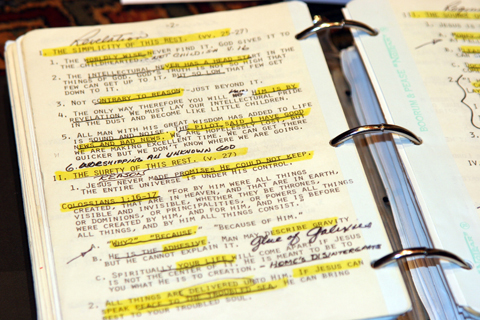
Growing up in my church tradition, there was an understanding that if you were a pastor or a pastor-in-training, you could be called up at any moment to give a sermon. It could be the night before when the usual preacher got sick or even a few minutes before the service if you were visiting another church and the pastor wanted to honor you by giving you the pulpit. Other times, experienced pastors may be asked to speak at a conference, prayer breakfast, retirement home service or more.
Depending on your level of competency and the amount of time at your hands, you may be able to write a new sermon. More often, you will find yourself needing to repreach a sermon you’ve previously delivered. There will be even be times when, decades apart, you return to a passage again. Even if the notice isn’t short, there may be value in returning a text you’ve worked through before because you know it will be especially helpful to the new audience that will hear the sermon.
Often preachers (and members!) joke about “warming up” something old. Preferably this is not what repreaching a sermon looks like! I would never suggest simply opening a file or hitting “print” on your computer and taking what’s there to the pulpit. Done well, repreaching can not only take advantage of your previous study, but give you a second chance to honor the text. But it requires thoughtfulness and intentionality. Here is a process that will help you get there.
Review Your Audience
It’s almost a given that the audience that first heard your sermon will be different the second time around. You likely preached first to your own congregation. You know them and their needs. They know you. There’s relationship of mutual love and trust. Now, you’re standing before another audience. Is this another church? Is it a group of pastor or ministry leaders? Will you be preaching to a church in another country or through an interpreter? Your application of the text and perhaps your tone/approach will be affected by who you are preaching to. So, think carefully about your audience.
Refresh Your Understanding
All good preachers are constantly growing in their understanding of the Bible. Reading, thinking, studying, praying over the Bible all yield a deeper grasp of individual passages as well as the sweep of the Bible’s grand narrative and how it all fits together. So, before you look at your previous outline or manuscript, read back over the text and make some quick notes. See if you can write out the main point and begin thinking about how you would apply it. This will give you a brief baseline or comparing what you did before. After this, it’s time to look over your previous work.
Refine Your Outline
Hopefully, you understood the text well the first time around. But if you’ve grown in your study abilities or preaching skills, you will want to review your original preaching outline. How can it be improved upon? Was there something that changed in your understanding that necessitates a change in the outline? Can it be tightened up or simplified? Can use you change something to better reflect the point of the text? Was it originally statements and you now want to change it to application-oriented imperatives? What, if anything, needs to change with your outline?
Revise Your Notes
This step will be necessary if you made any changes made to your understanding or outline. But even if no changes were made there, you could need to revise your preaching notes. This starts with your audience. Is there anything that’s outdated and needs to be dropped, something should be added to help the audience to better connect with you, or a tweak to make your message clearer? For example, an illustration for your church may be too culturally bound for an international church (this is the same for humorous comments). If you’re revising a full manuscript, it may be the case and your can reword sections or even eliminate wordiness. Whatever it is, read back through every word of your notes and make any needed changes.
Rekindle Your Heart
This is perhaps the most important part of repreaching a sermon text. Whenever you’re prayerfully preparing a sermon for the first time, God works that passage into your soul. Like Jeremiah, it becomes a fire in your bones, leaving you unsatisfied until you preach the text (Jer 20:9)! But that fire must be rekindled if you are going to display the same passion and verve as you did during your first time preaching the text. Part of that stoking of the embers will naturally happen as you work through the previous steps, reading over the passage and considering how to clearly teach and apply it’s message as you revise your notes. But pray for it too. Read over the text and notes, asking the Lord to work that message into your mind and heart again and give you a passion to preach his Word.

 MAGNIFY CHRIST